Likelihood and the Particle Filter
How the particle filter, IF2, PGAS, and NUTS work, what the diagnostics mean, and how the fitting pipeline connects them.
1. The likelihood you want but can’t have
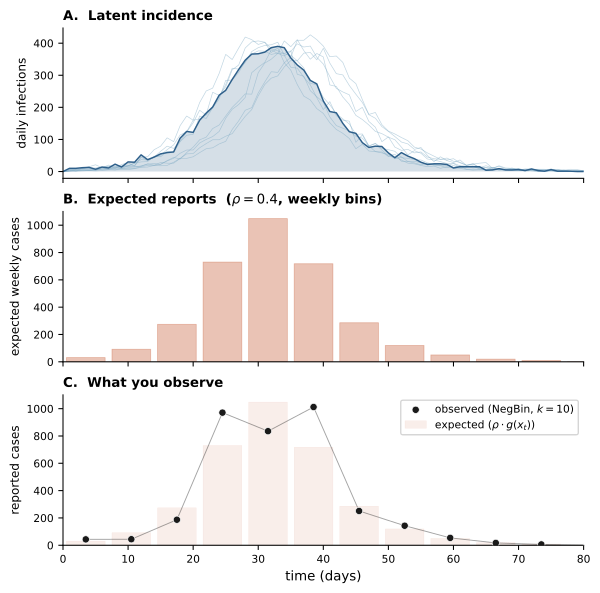
A compartmental model defines a stochastic process over a latent state \(x_t\) — the compartment populations (S, E, I, R) evolving through time. You never observe this state directly. What you observe is a noisy, incomplete projection: weekly case reports, seroprevalence surveys, death counts.
The goal of inference is to recover model parameters from these observations. This means evaluating the marginal likelihood — the probability of the observed data \(y_{1:T}\) given parameters, integrated over all possible latent trajectories:
\[p(y_{1:T} \mid \theta, \varphi) = \int p(y_{1:T}, x_{0:T} \mid \theta, \varphi) \, dx_{0:T}\]
This integral is over every possible path the epidemic could have taken. For a model with thousands of individuals tracked over hundreds of observation times, it is intractable.
But the integrand — the joint density of data and trajectory — factors into pieces you can reason about:
\[p(y_{1:T}, x_{0:T} \mid \theta, \varphi) = \underbrace{\prod_{t=1}^{T} p(y_t \mid x_t, \varphi)}_{\text{observation likelihood}} \cdot \underbrace{\prod_{t=1}^{T} p(x_t \mid x_{t-1}, \theta)}_{\text{transition likelihood}} \cdot \; p(x_0 \mid \theta)\]
Both factors are likelihoods — conditional probabilities viewed as functions of parameters. Together they form the complete-data likelihood: the probability of everything you know (data + trajectory) given parameters. The marginal likelihood integrates the transition likelihood over trajectories; the complete-data likelihood doesn’t.
Two kinds of parameters appear:
- \(\theta\) — dynamics parameters: transmission rate \(\beta\), recovery rate \(\gamma\), overdispersion \(\sigma^2\), initial conditions. These control how the epidemic unfolds.
- \(\varphi\) — observation parameters: reporting probability \(\rho\), dispersion \(k\), detection probability. These control how the data relates to the latent trajectory.
This factorization is the organizing principle of everything that follows. The observation likelihood depends on \(\varphi\) only. The transition likelihood depends on \(\theta\) only. Every inference algorithm is a strategy for handling these two pieces.
Throughout this book, log-likelihoods use the natural logarithm (base \(e\)), so the unit is the nat — the natural unit of information. A difference of 1 nat between two models means one assigns \(e \approx 2.72\) times higher probability to the data. A difference of 3 nats is a factor of ~20; 5 nats is ~150×.
The nat scale is universal across all likelihood-based comparisons in camdl: IF2 log-likelihoods, PGAS posterior densities, elpd in model comparison, and the E_T e-value column (exp(Δelpd) converts nats back to a probability ratio). When you see “the log-likelihood improved by 2 nats,” that means the better model assigns ~7× higher probability to the observed data. When the improvement is 0.5 nats, it’s only ~1.6× — probably noise.
(Information theorists use bits (log₂); Bayesians and physicists use nats (ln). The choice is a constant factor: 1 nat ≈ 1.44 bits. camdl uses nats because \(\ln\) is what falls out of the math naturally.)
2. Observation likelihood — the piece you can always evaluate
Given a trajectory \(x_{0:T}\) (simulated or sampled), the observation model computes the probability of the data at each observation time. This is cheap, closed-form, and shared by every algorithm in camdl.
How it works
At each observation time \(t\), the model projects the latent state into an observable quantity — typically cumulative flows (incidence) or current compartment counts (prevalence). The observation likelihood then scores the observed data against this projection:
\[p(y_t \mid x_t, \varphi) = f(y_t \mid g(x_t), \varphi)\]
where \(g(x_t)\) is the projection (e.g., total infection flows since last observation) and \(f\) is the likelihood family.
Example: negative binomial case counts
The most common observation model in camdl. Weekly reported cases are a fraction \(\rho\) of true incidence, with overdispersion \(k\):
\[y_t \sim \text{NegBin}\bigl(\text{mean} = \rho \cdot g(x_t),\; r = k\bigr)\]
where \(g(x_t)\) sums the infection flow accumulator over the observation interval. The log-density:
\[\log p(y_t \mid x_t, \varphi) = \log \Gamma(y_t + k) - \log \Gamma(k) - \log(y_t!) + k \log\!\frac{k}{\mu + k} + y_t \log\!\frac{\mu}{\mu + k}\]
with \(\mu = \rho \cdot g(x_t)\) and \(\varphi = (\rho, k)\).
This is one function evaluation per observation time — bounded, smooth, differentiable in \(\varphi\).
Why this matters
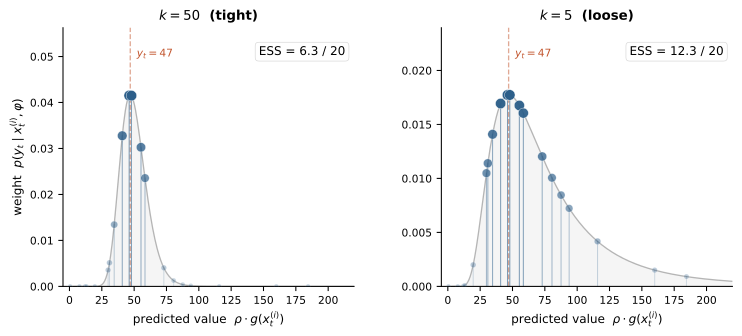
When ESS collapses in the particle filter, it’s because the observation likelihood is sharply peaked. The data says “roughly 47 cases this week” and most simulated trajectories produced 0 or 500. More particles help (better coverage of the likely region). Looser observation models help (wider \(k\) spreads the weight across more particles). Understanding the observation likelihood as a weighting function — not just a statistical formality — is the key diagnostic intuition.
3. Transition likelihood — the piece that separates the algorithms
The transition likelihood \(p(x_t \mid x_{t-1}, \theta)\) is the probability of the specific compartment changes that occurred between time steps, viewed as a function of \(\theta\). Whether you can evaluate this density pointwise (not just simulate from it) determines which inference algorithms are available.
Chain-binomial: closed-form density available
In the chain-binomial (Euler-multinomial) backend, one time step draws events from a product of binomials. For each source group \(g\) with source count \(n_g\) and exit probability \(p_g\):
\[p(\text{flows}_g \mid x_{t-1}, \theta) = \text{Multinomial}(\text{flows}_g \mid n_g, p_g)\]
where \(p_g = 1 - \exp(-\text{rate}_g \cdot dt)\) and rates are computed from the propensity expressions.
With overdispersion (\(\sigma^2 > 0\)), the per-capita rate is Gamma-distributed:
\[\gamma_g \sim \text{Gamma}\!\left(\frac{dt}{\sigma^2},\; \frac{\sigma^2}{dt}\right)\]
and the full transition likelihood becomes:
\[p(x_t \mid x_{t-1}, \theta) = \prod_g \text{Multinomial}(\text{flows}_g) \cdot \prod_g \text{Gamma}(\gamma_g)\]
Both terms are closed-form. This is what makes PGAS possible for chain-binomial models: you can evaluate the transition likelihood pointwise, not just simulate from it.
Gillespie / tau-leap: closed-form density not available
For Gillespie SSA, evaluating \(p(x_t \mid x_{t-1}, \theta)\) involves the full sequence of exponential waiting times and event selections — available in principle but computationally expensive for a discretized observation schedule. For tau-leap, the Poisson approximation makes pointwise evaluation feasible but less commonly used in practice.
The key consequence: IF2 and PMMH work with any backend (they only need simulation). PGAS requires chain-binomial (it needs to evaluate the transition likelihood). This isn’t a limitation of the implementation — it’s a fundamental property of the algorithm.
Why the Gamma term matters
The overdispersion Gamma factor \(p(\gamma_g)\) is part of the transition likelihood. If you evaluate it without the Gamma term, you’re computing \(p(\text{flows} \mid \gamma, \theta)\) instead of \(p(\text{flows}, \gamma \mid \theta)\). The complete-data log-likelihood is wrong, and its gradient (used by NUTS) is inconsistent with the value — proposals drift, acceptance rates drop, chains don’t converge.
This is not a theoretical concern. It’s the root cause of real bugs. The Gamma term is modest in magnitude (often a few log-units per substep) but the gradient effect accumulates across hundreds of substeps.
Choosing a backend
The backend determines both the simulation mechanics and which inference algorithms are available. The choice matters more than it might seem — each makes a different approximation.
The names reflect historical accident more than structural difference. The chain-binomial model (Reed & Frost, taught at Johns Hopkins in the 1920s–30s; published by Abbey 1952; systematized in Bailey 1975) discretizes an epidemic into generations: at each step, \(I_{t+1} \mid S_t, I_t \sim \text{Binomial}(S_t, 1 - q^{I_t})\). “Chain” because it’s a Markov chain; “binomial” because each transition is a binomial draw.
The Euler-multinomial (Bretó et al. 2009; He et al. 2010) generalizes this to continuous-time models with competing exits — an \(I\) individual can recover, die, or be reported — discretized at step size \(\Delta t\). The exits are multinomial rather than binomial, with probabilities derived from the competing hazards: \(p_j = (\lambda_j / \lambda_{\text{tot}})(1 - e^{-\lambda_{\text{tot}} \Delta t})\). Chain-binomial is the special case with one exit per compartment and \(\Delta t\) equal to one generation.
Both are finite-population stochastic models where each time step is a joint draw of how many individuals move along which edge, conditional on current compartment sizes. The transition kernel is a composition of independent individual-level draws — which is why the density is closed-form and why particle-filter-based inference works.
For readers with a population genetics background: the structure is the same as a Wright-Fisher model with multiple allelic classes. Replace “allele frequency” with “compartment fraction,” replace “selection coefficient” with “force of infection minus recovery,” and the transition kernel is the same multinomial-conditional-on-current-state object. The identifiability geometry is similar too: in Wright-Fisher, \(N_e\) and selection \(s\) are partially confounded from a single-locus trajectory; in stochastic SIR, \(R_0\) and reporting rate \(\rho\) have the same issue on a single outbreak — you observe \(\rho R_0\)-like combinations cleanly but need additional structure to separate them. Both are cases where a single realization of a finite-population Markov chain under-determines the generator. The key biological difference is the depletion-of-susceptibles nonlinearity: \(S\) decreases monotonically during an outbreak, making the drift strongly state-dependent in a way neutral genetics doesn’t see.
Use chain-binomial when you plan to fit the model. It’s the only backend that provides a closed-form transition density, which unlocks PGAS (the most efficient Bayesian algorithm for these models). It also works with IF2 and PMMH.
The chain-binomial is a discrete-time scheme: at each step \(dt\), rates are converted to probabilities \(p = 1 - \exp(-\text{rate} \cdot dt)\) and events are drawn from a multinomial. The multinomial correctly handles competing risks — if compartment \(I\) has both recovery and death transitions, they compete for the same individuals, and their combined exits can never exceed \(I\). This is guaranteed by construction.
Overdispersion (\(\sigma^2 > 0\)) enters naturally: the per-capita force of infection is scaled by a Gamma random variable before the probability conversion. Both the multinomial and Gamma terms have closed-form densities, so the full transition likelihood is evaluable. This is what He et al. (2010) used for London measles, and it remains the standard in pomp.
Discretization bias from large \(dt\). The chain-binomial assumes rates are constant within each step. When compartment sizes change substantially during \(dt\) — for instance, \(I\) doubling in one day during exponential growth — the rate at the start of the step doesn’t represent the dynamics within it. The approximation error is \(O(dt)\) (first-order Euler).
Rule of thumb: \(dt\) should be small enough that no compartment changes by more than ~10% in a single step. For fast epidemics in small populations (the boarding school at peak: \(\Delta I / I \approx 50\%\) per day), use \(dt = 0.5\) or smaller. For slower dynamics or large populations, \(dt = 1\) is usually fine.
Jensen’s inequality with overdispersion. Because the Gamma noise enters before the nonlinear \(1 - \exp(\cdot)\) conversion, adding mean-preserving noise to the rate slightly reduces the expected infection probability (§ overdispersion in the experiments chapter). This means parameters estimated under an overdispersed model are not directly comparable to parameters from a non-overdispersed model — the model structure and parameters are entangled.
Computational cost: \(O(G)\) per substep, where \(G\) is the number of source groups (transition clusters sharing a source compartment). Much cheaper than Gillespie for large populations. The cost scales with model structure, not with population size.
Use Gillespie when you need an exact stochastic simulation and don’t plan to run PGAS. (Gillespie, 1977) Every event (each individual infection, each recovery) is simulated at its exact time — no discretization error, no \(dt\) to tune. The result is the “ground truth” stochastic process. It works with IF2 and PMMH for inference.
Gillespie is the right choice for small populations where discrete effects matter (a handful of initial infections, near-extinction dynamics) and for validation — comparing Gillespie output against chain-binomial at various \(dt\) tells you whether your \(dt\) is small enough.
Cost scales with event count, not time span. Each step simulates one event. For a population of \(N = 10{,}000\) with \(R_0 = 3\), the total number of events (infections + recoveries) is \(\sim 20{,}000\). For \(N = 3.3\) million (London), it’s \(\sim 6\) million events per simulation. At \(dt = 0.5\), the chain-binomial handles the same dynamics in ~\(2T\) steps regardless of \(N\).
No closed-form transition density for discretized observations. Evaluating \(p(x_t \mid x_{t-1}, \theta)\) for a Gillespie trajectory between observation times requires tracking every intermediate event — available in principle but not implemented in camdl. This rules out PGAS. For Bayesian inference with Gillespie, use PMMH.
Overkill for large populations. When \(N\) is large enough that the law of large numbers smooths out individual-level randomness, the exact event-by-event simulation adds precision that no observation model can distinguish. The chain-binomial with \(dt = 0.5\) produces statistically indistinguishable results at a fraction of the cost.
Use tau-leap for rapid exploration (Cao, Gillespie & Petzold, 2006) when you want speed over precision — prior predictive checks, sensitivity sweeps, quick iterations on model structure. Each step draws event counts from independent Poisson distributions, approximating the Gillespie process at discrete time steps.
Tau-leap is typically the fastest backend, and it works with IF2 and PMMH for inference.
Independent Poisson draws don’t respect competing risks. Unlike the chain-binomial’s multinomial, tau-leap draws each transition independently. If compartment \(I\) has 50 individuals and two exits (recovery, death) each with high probability, the independent Poisson draws can produce \(35 + 25 = 60\) total exits from 50 individuals. camdl clamps negative compartments to zero, but this introduces bias — the effective exit rate is lower than intended.
This bias is worst at epidemic peaks — exactly when compartments are large, rates are high, and multiple transitions compete. For models with a single exit per compartment (simple SIR where \(I\) only has recovery), tau-leap and chain-binomial are nearly equivalent. For models with competing risks (SEIR with I→R and I→D, or overdispersed infection alongside recovery), the chain-binomial is more faithful.
No PGAS. Like Gillespie, tau-leap doesn’t provide a transition density suitable for PGAS. Use chain-binomial if you want full Bayesian inference.
4. Three strategies for the intractable integral
Recall from above that the likelihood of the observed data \(p(y_{1:T} \mid \theta, \varphi)\) is intractable, since it’s an integral over all possible trajectories. There are three approaches to get around this:
| Strategy | Algorithm | What it computes | Needs transition likelihood? |
|---|---|---|---|
| Estimate the integral stochastically | Particle filter | \(\hat{p}(y \mid \theta, \varphi)\) | No |
| Maximize it | IF2 | \(\arg\max_\theta p(y \mid \theta, \varphi)\) | No |
| Avoid it — work with the joint directly | PGAS | \(p(\theta, \varphi, x \mid y)\) | Yes |
IF2 and the particle filter only need the observation likelihood (§2) and the ability to simulate forward. They never touch the transition likelihood. PGAS uses both pieces — observation likelihood AND transition likelihood — to evaluate the complete-data log-posterior directly, bypassing the intractable integral entirely.
PMMH occupies a middle ground: it uses the particle filter’s stochastic estimate of the marginal likelihood as an MCMC acceptance ratio.
The choice between these strategies is the central decision of the fitting workflow. The callouts below summarize the practical tradeoffs — when each algorithm is the right tool, and what can go wrong.
Use IF2 when you want a point estimate (MLE) and work with any backend. IF2 is the right first step in almost every workflow: it’s fast, requires only forward simulation, and finds the parameter region where the model fits the data. It scales to ~10–15 estimated parameters in standard settings (King et al., 2016).
Start here. Run 8+ chains from dispersed starting points (the scout stage). If chains converge to the same region (\(\hat{R} < 1.1\)), you’ve found the MLE. If they find different basins, the likelihood surface is multimodal — examine which basin has the highest validated log-likelihood.
IF2 finds local optima, not global ones. The cooling schedule contracts the perturbation cloud around whatever basin particles happen to land in. Multistart is mandatory: a single chain gives no convergence guarantee on a multimodal surface. The more parameters you have, the more starts you need.
Cooling schedule interacts with exploration. Gentle cooling (cf50 ≈ 0.5–0.7) maintains large perturbations longer, allowing particles to jump between basins. Aggressive cooling (cf50 ≈ 0.05) converges fast but traps you in the nearest peak. Use gentle cooling for scouting, aggressive for refining.
The reported log-likelihood is inflated. IF2’s log-likelihood during optimization includes perturbation noise and is always higher than the true marginal likelihood. Always validate with a clean particle filter (no perturbations) before comparing models or computing profile likelihoods.
Filtering failure = model failure. If the PF returns \(-\infty\) (all particles get zero weight), the model structure is wrong — no amount of parameter tuning will fix it.
Use PGAS when you need full Bayesian uncertainty and your model uses the chain-binomial backend. PGAS produces posterior samples of both parameters and trajectories — credible intervals, posterior predictive checks, and the full distribution of epidemic histories consistent with the data.
Because PGAS pairs with NUTS for parameter updates (using exact gradients of the complete-data log-posterior), it handles correlated parameters (\(\beta\)–\(\gamma\) anticorrelation through \(R_0\)) far more efficiently than random-walk proposals. This makes it the preferred algorithm when the chain-binomial backend is available — which is the default for camdl’s target models.
Low trajectory renewal is the primary failure mode. After each CSMC sweep, check what fraction of the trajectory substeps changed. If renewal is below ~10%, the reference particle dominates — parameters may appear to mix while the trajectory is frozen. Remedies: more CSMC particles, or parallel tempering to escape local modes.
Observation frequency matters more than time span. CSMC difficulty scales with the number of observation times \(T\), not calendar duration. Weekly observations over 15 years (\(T \approx 780\)) require substantially more CSMC particles than monthly observations (\(T \approx 180\)). The number of CSMC particles must grow roughly proportional to \(T\) (Singh et al., 2017).
The Gibbs coupling problem. PGAS alternates parameter and trajectory updates. When the two are strongly correlated in the posterior (higher \(\beta\) ↔︎ higher-incidence trajectory), neither can move far without the other. Ancestor sampling helps, but for severe coupling, parallel tempering across the likelihood surface is the standard remedy.
Requires chain-binomial. This is a hard constraint: if your model needs Gillespie or tau-leap dynamics, PGAS is not available. Use PMMH for Bayesian inference or IF2 for MLE.
Use PMMH when you need Bayesian inference but can’t evaluate the transition likelihood — non-chain-binomial backends, or as a cross-validation check against PGAS on the same model. PMMH uses the particle filter’s noisy likelihood estimate in a Metropolis-Hastings ratio, and remarkably, the resulting chain targets the exact posterior despite the noise (Andrieu et al., 2010).
Best suited for models with few parameters (3–6), where the random-walk proposal remains efficient.
Tune particles so \(\text{Var}[\log \hat{p}(y \mid \theta)] \approx 1\)–\(3\) at the posterior mode (Doucet et al., 2015). Too few particles → high variance → the chain gets “stuck” at accidentally high likelihood estimates. Too many → wasted computation. But variance is not constant across parameter space: it typically increases in the posterior tails, so tuning at the mode can produce an artificially concentrated posterior.
Required particles grow with \(T\). PF log-likelihood variance grows linearly with the number of observation times. For long time series (\(T > 200\)), this can mean thousands of particles per MCMC step — each of which runs a full PF. This makes PMMH expensive for the multi-decade time series common in measles and polio modeling.
Scales poorly with parameters. Random-walk proposals require step sizes \(\propto d^{-1}\) for \(d\) parameters, meaning exploration slows rapidly. Beyond ~6–8 parameters, chains require impractically long runs. PGAS with NUTS avoids this via gradient-informed proposals.
“More iterations” doesn’t fix “too few particles.” Mixing time scales exponentially with log-likelihood variance (Pitt et al., 2012). Doubling particles roughly doubles per-iteration cost but can dramatically improve effective samples per unit time. If doubling \(N\) more than doubles your ESS, your current \(N\) is too small.
5. The particle filter
The bootstrap particle filter (Gordon, Salmond & Smith 1993) estimates the marginal likelihood by running many simulated trajectories (“particles”) in parallel and resampling them to match the data.
Algorithm
At each observation time \(t\):
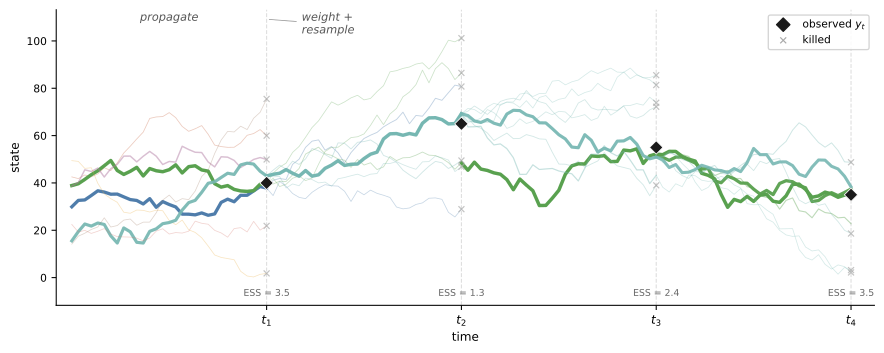
- Propagate. Advance all \(N\) particles from \(t-1\) to \(t\) using the process model (\(\theta\), simulation). No likelihood evaluation needed.
- Weight. Score each particle against the data: \(w_t^{(i)} = p(y_t \mid x_t^{(i)}, \varphi)\) — the observation likelihood from §2.
- Resample. Draw \(N\) particles with replacement, proportional to weights. Particles near the data survive; unlikely ones die.
The log-likelihood estimate is the sum of log-normalizing constants:
\[\log \hat{p}(y_{1:T} \mid \theta, \varphi) = \sum_{t=1}^{T} \log\!\left(\frac{1}{N} \sum_{i=1}^{N} w_t^{(i)}\right)\]
This is an unbiased estimate of the marginal likelihood on the probability scale. Its variance decreases with more particles.
ESS — the primary diagnostic
Effective Sample Size measures particle diversity after weighting:
\[\text{ESS}_t = \frac{\left(\sum_i w_t^{(i)}\right)^2}{\sum_i \left(w_t^{(i)}\right)^2}\]
ESS = \(N\) when all weights are equal (data is uninformative or process matches perfectly). ESS = 1 when one particle captures all the weight (data is sharply informative, most trajectories miss).
What low ESS means: The observation likelihood (§2) is concentrating weight on a few particles. During epidemic peaks, most simulated trajectories don’t match the case count closely enough. The PF is still unbiased — the surviving particles are correct — but variance is high.
What to do about it: More particles (brute force). Or looser observation model: estimate \(k\) (NegBin dispersion) rather than fixing it, or add overdispersion (\(\sigma^2\)) to increase process noise. Both widen the effective proposal, keeping more particles alive.